
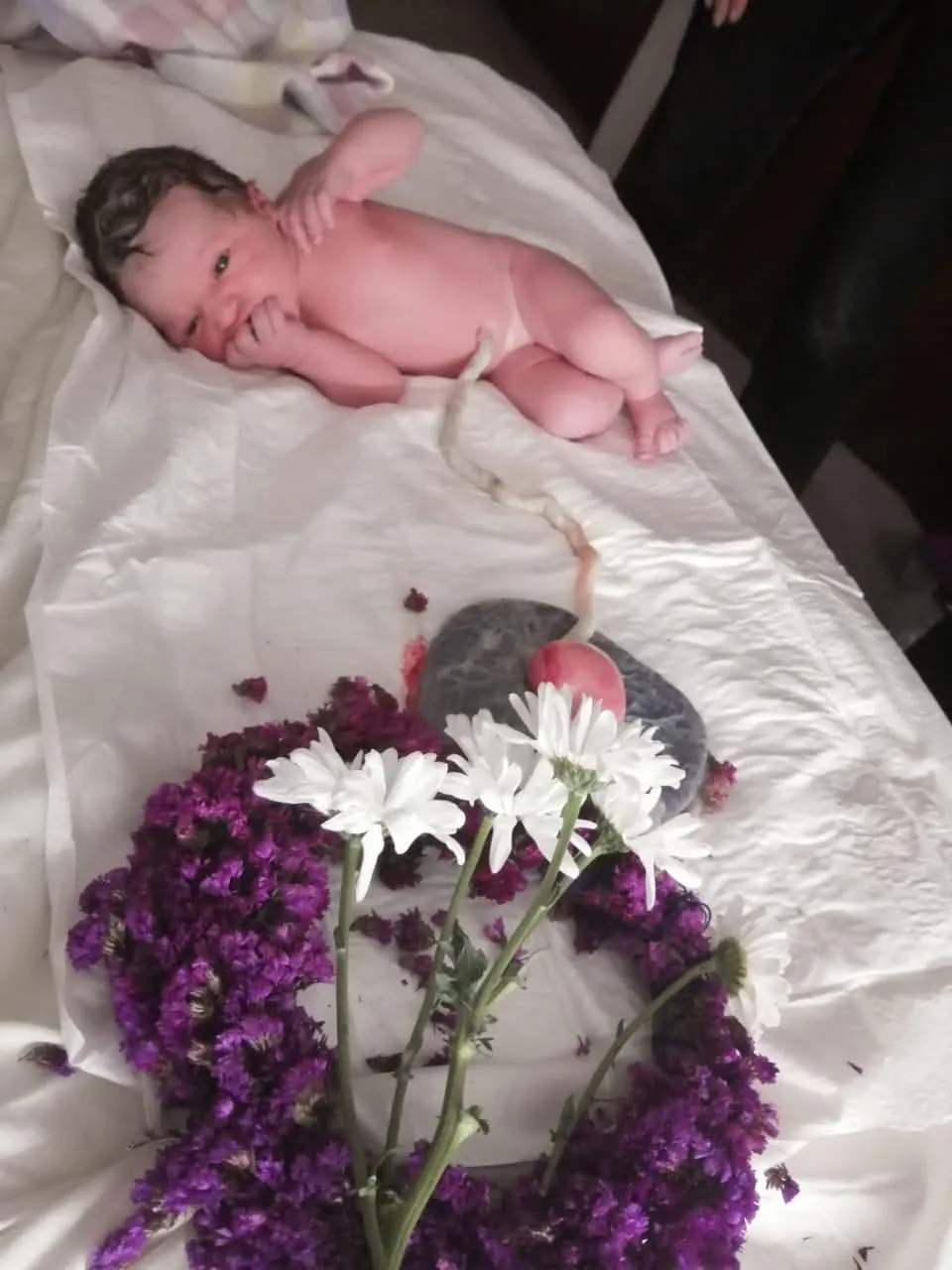
There is something deeply special about birth:
no birth is ever the same as another. Never.
Just as each of us is unique, so is the way we enter this world.
No two births are the same. No two bodies are the same. No two babies are the same. No two stories are the same.
And perhaps that is precisely why birth is so difficult to explain, describe, plan and predict.
We live in a world in which we like to know.
We like to prepare. To make plans. To organize. To set schedules. To have protocols. To know what comes next.
And that makes sense.
Our neocortex works this way. It likes to understand, organize, anticipate and find answers. It seeks safety in what it can know and predict.
And here, for me, lies one of life's great ironies:
we find it so difficult to make space for mystery, even though mystery is exactly where we come from.
Before we were born, we knew nothing about this world.
We didn't know what a day was, an hour, a home, a family, a voice, a light.
And yet, we arrived.
Life knew how to do it.
Birth Is A Mystery
Birth is mysterious.
Unpredictable.
Big.
Deep.
Raw.
Beautiful.
Sometimes even difficult to understand.
It is one of those moments when life happens through us, and we cannot control every detail of what is taking place.
And perhaps that is also part of its beauty.
We can prepare.
We can inform ourselves.
We can learn about our bodies, the different possibilities, processes and our options.
We can ask questions and make conscious decisions.
But we cannot know exactly how our birth will begin, when it will happen, how long it will last or which path it will take.
And perhaps we don't need to know everything.
Perhaps we need to learn to live with a part of the unknown.
How Does Birth Begin?
Here, we can give our neocortex a little information.
Because although we cannot predict exactly how our birth will unfold, we can learn about some of the ways it may begin.
And here is something important:
there is no single order.
Maybe A comes first, then B, and then C.
Or B, C and A.
Or C and A.
Or perhaps one of these elements is barely noticeable.
Birth does not necessarily follow a script.
It can begin in many different ways.
Sometimes It Begins With Your Waters
Sometimes the first thing that happens is the rupture of the membranes.
It can happen while you are moving or while you are completely still.
It may feel like a tiny pop, or it may happen without any sound at all.
There may be a large gush or just a few drops.
And afterwards, contractions may begin right away.
Or some time may pass before they appear.
So when your waters break, it can be helpful to notice a few things:
What color is the fluid? What does it smell like? Was there a lot or just a little? Is fluid still coming out?
These are small details that can give you some orientation and that you can share with your midwife or healthcare professional.
And something very important:
breaking your waters does not necessarily mean that your baby will be born immediately.
Birth has its own rhythm.
Sometimes It Begins With Contractions
Another possibility is that labor begins with contractions.
Perhaps you barely notice them at first.
Suddenly your belly becomes hard and you feel a sensation in your lower abdomen, pelvis or sacrum.
It may be sporadic at first.
A brief wave of twenty or thirty seconds that you can still breathe through while continuing with whatever you were doing.
Then another may come.
And another.
Perhaps they gradually become more intense.
At some point, you may reach a moment when you can no longer simply continue with what you were doing and need to stop, breathe and become more present.
You can move your pelvis.
Sway.
Breathe.
And perhaps remember one word:
softness.
Softness in the pelvis.
Softness in the jaw.
Softness in the vagina.
Not because you have to do anything perfectly, but as an invitation to create space and allow your body to do its work.
Little by little, the contractions may begin to organize themselves.
They become closer together. They become more rhythmic.
Longer.
More intense.
And at some point, you may feel that something has changed.
You are no longer simply waiting.
You are entering birth.
And Then The Journey Begins
As labor progresses, many women experience a shift in their relationship with the outside world.
Their attention turns inward.
Conversations become less important.
Time may feel different.
The body begins to occupy all the space.
As if you were climbing a mountain.
Each contraction is a new wave.
A wave of expansion.
A wave of strength.
A wave that you can breathe through, feel and move through.
And perhaps there is less and less space for thinking and more and more space simply to be.
Another kind of wisdom may appear here.
A wisdom that does not need words.
And Sometimes The Mucus Plug Appears
The mucus plug may also come away before birth.
This jelly-like substance can be clear, whitish, pink or brown, and may contain small streaks of blood.
You may notice it when wiping after going to the bathroom.
And here too, we find one of the fascinating things about the variability of birth:
It may come away days before. It may come shortly before. It may come during labor. Or you may not even notice when it comes away.
My teacher Angelina once told me the story of a woman who passed small amounts of mucus plug over several days.
Until, slightly desperate, she finally asked:
“How many liters of mucus plug do we actually have?”
I love this story because it shows something essential:
birth does not always follow our expectations.
What We Know And What We Don'T Know
We can learn so much about birth.
We can learn about the body.
About hormones.
About contractions.
About the different stages of labor.
About our options.
About the places where we can give birth.
About who can accompany us.
About interventions and alternatives.
All of this knowledge can be deeply valuable.
But there is a difference between being informed and believing that we can control birth.
We can prepare for the journey.
But we cannot know every curve before we walk it.
And perhaps good preparation is not the kind that gives us every answer.
Perhaps it is the kind that gives us enough resources to meet whatever comes.
When The Neocortex Wants To Know Everything
Perhaps there is a part of you that wants to know:
When will it begin?
What time will my baby be born?
How long will it last?
Will my waters break first?
When should I go to the hospital?
Will it be day or night?
Will I be able to do it?
What if something changes?
These are human questions.
And they deserve answers, information and support.
But perhaps there comes a moment when we can gently say to our neocortex:
“You can know many things. But you don't need to know everything.”
Because there is a part of birth that belongs somewhere else.
Somewhere deeper.
More embodied.
More intuitive.
Beyond our plans.
Less Noise. More Listening.
We live in a time deeply oriented toward knowledge, planning and control.
And of course, this has also brought enormous benefits.
But perhaps around birth we also need to remember something else:
the body needs space to express itself.
When there are constantly outside voices asking:
Has it started yet? Still not? Shouldn't your baby have been born by now? Isn't your due date already behind you?
it can become difficult to hear what is happening within.
For me, protecting the space around birth also means protecting the silence.
Less pressure.
Fewer expectations.
Fewer outside voices.
More presence.
More listening.
More trust.
This does not mean rejecting knowledge or medicine.
It means creating a space where knowledge and safety can coexist with trust in the body and in the process.
When We Quiet The Outside
Perhaps one of the gifts of preparing for birth is precisely this:
learning to turn inward.
To listen.
To feel.
To breathe.
To recognize our needs.
To distinguish between an outside voice and our own voice.
To trust our body without having to understand everything that is happening.
And perhaps then we can allow our neocortex to rest a little.
To let another part of us take up space.
The body.
Intuition.
Emotion.
Connection.
We can embrace the unknown without giving up being informed.
We can prepare without trying to control.
We can have a plan and, at the same time, remain open to the possibility that life will write some parts of the story itself.
The Mystery Of Life
Perhaps this is what fascinates me most about birth.
That despite all our knowledge, our plans, our protocols, our statistics and our questions...
life remains greater than us.
We do not know exactly when it will begin.
We do not know exactly what it will be like.
We do not know which path it will take.
But we know how it ends:
with a baby being born.
And perhaps that certainty is enough for our neocortex.
A small island of safety within an ocean of mystery.
Because in the end, birth does not need us to fully understand it.
It needs space.
Presence.
Respect.
Trust.
And perhaps, above all, our willingness to meet the unknown.
To breathe.
To open.
To surrender.
To let life happen.
Because that is what life does.
Life happens.
And when we stop trying to control everything, perhaps we can come a little closer to witnessing the miracle that has been there all along:
the miracle of life.